
www.HealthyHearing.com |
Taming the tinnitus stress response: Patience is keyHow to retrain your brain to respond more effectivelyWhen you live with bothersome tinnitus, there are countless coping techniques that can provide effective relief, but they are rarely the quick fix we hope for. 
The reality is it takes much longer to calm the nervous system than most people realize, especially when stress and anxiety levels are running high. This disconnect between expectations and physiology is one of the primary reasons people often feel like their coping tools are not working. In the middle of an intense moment of tinnitus distress, the body can remain in a heightened state of arousal long after you begin trying to relax. As a result, many people give up too quickly, thinking their efforts have failed. But it’s not true. It’s simply a misunderstanding of the biology behind this challenging experience. Once you understand what’s happening inside your nervous system during these moments, you can begin to work with your body instead of fighting against it. And when your expectations match your physiology, your coping tools will not only seem more effective, but more reliable as well. In this column, we are going to explore why tinnitus coping often works slowly, what’s really happening in the nervous system during difficult moments, and how to use that understanding to make your coping tools more effective. Most coping efforts are too short to be effectiveWhen you're experiencing a difficult moment of tinnitus-related anxiety—and you’re using a coping technique that feels like it isn't working—you are almost certainly wrong. In almost every instance, the technique is likely working fine. The problem is that you have not used the technique for long enough to achieve the relief you expected, given the physiology of the moment. Most people greatly underestimate the time it takes to calm the nervous system back down from an intense state of sympathetic activation. To understand why it can take so long to cope effectively, it helps to explore a more ordinary example of a stress response everyone has experienced in day-to-day life. A common example: A fight-or-flight false alarm in the carImagine you are sitting in the front passenger seat of a car, listening to the radio and browsing social media, while a loved one drives you home. Suddenly, your loved one slams the brakes to avoid a collision with the car in front of you, whose driver wasn’t paying attention and had to brake hard to avoid hitting the next car. In a situation like this, you will experience a classic fight-or-flight stress response, and your body will react in a predictable way. Several things will happen all at once: stress hormones like cortisol and adrenaline instantly flood your blood stream, your muscles tense up in anticipation of a crash, your senses will sharpen—especially your vision and hearing—and you will look up to take in the scene. Almost immediately, you will realize that you are safe. For a brief moment, it might have felt like you were in danger, but that is only because you were immersed in your phone and oblivious to your surroundings. Your loved one was paying full attention and reacted quickly. There was no real risk of a serious accident. All of this will unfold in a matter of seconds, but when it’s over, you will not instantly return to the relaxed state you were in moments earlier, playing on your phone. It will likely take another 15 to 20 minutes of feeling safe—of knowing you are safe—for your nervous system to full settle back down. 
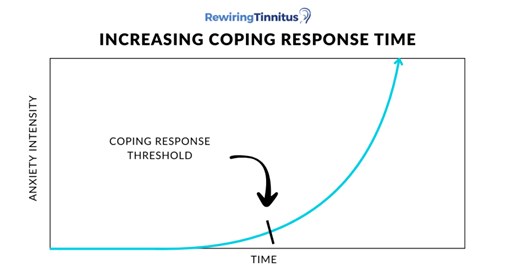
Calming the sympathetic storm of tinnitus distressNow compare this experience to an intense moment of tinnitus distress, where the sound that is triggering the fight-or-flight response doesn’t stop, and there is no equivalent experience of “looking up and realizing that you are safe.” What this tells us is that it may take 15 to 20+ minutes of continuous relaxation effort and stimulus to even begin to come out of fight-or-flight, and much longer to achieve meaningful state of calm. In these moments, it’s extremely difficult to sit there using a coping technique over and over, like a breathing exercise, when it feels like it isn’t working. Remember: It is working. It just takes a lot more time and effort than you are expecting. Understanding and implementing this one concept can dramatically improve your results, regardless of the coping tool, technique, or strategy you are trying to use. I always tell my tinnitus coaching clients that you are never without the power to calm your nervous system down, even when experiencing intense panic. The only thing that changes as anxiety intensifies is the time it will take to achieve results. The techniques that tend to work best are the ones we stay with long enough for our nervous system to actually be able to downshift. Even the simplest breathing exercises can calm intense anxiety when practiced repeatedly for long enough. But that doesn’t mean that all coping tools and strategies are created equal. In the next few sections, we will explore specific strategies to increase your coping ability further. Increasing your speed-to-tools (AKA coping response time)Now that we understand the level of effort and time required to calm our nervous system, we need to understand the next barriers to faster tinnitus coping: How quickly a negative emotional response can escalate and the way it can distort your ability to think rationally. When you first notice a moment of anxiety, it can feel like you went from 0-100% intensity all at once, but that is never the case. Anxiety, and other intense emotional responses like anger, tend to increase exponentially over a short period of time, and many people don’t notice this happening until it’s too late. Tinnitus anxiety often feels like a wave crashing over your head because by the time you are aware of what is happening, the anxiety response has already spiked.
But you can train yourself to notice the anxiety response closer to the moment it first begins and dramatically increase the speed at which you intervene. When you can react with a positive coping action early enough, you can often stop the emotional response from escalating entirely. The coping response threshold
When a moment of intense tinnitus anxiety first begins, there is a brief period of time where your coping actions are much more likely to be effective. This short window of opportunity ends at what I call the “coping response threshold,” which is the point at which your anxiety is increasing faster than you can calm yourself down. This is the moment when coping becomes a much bigger challenge. But remember that it’s always possible to cope with tinnitus anxiety, even if it has escalated into a full-on panic attack. It just requires an exponentially longer coping effort to calm everything back down. The goal is to improve your ability to catch anxiety or a negative emotional response as it’s first starting, so you can use a coping technique to shut it down before you cross the coping response threshold. How to improve your response timeIn my opinion, the most effective way to improve your coping response time is through repetition and classical conditioning. All you have to do is choose a single (ideally simple) coping technique and use it repeatedly any time you notice your tinnitus, until it becomes an automatic conditioned response. This always takes time, but with enough repetition, you will notice yourself reflexively using the coping technique closer and closer to the moment the negative response begins. Being able to instinctively react to tinnitus anxiety in a way that shuts down the emotional response before it takes hold of you is like a coping superpower. In the next section, I will teach you a highly effective coping technique you can use in your speed-to-tools training, one that can also help quickly restore rational thinking. Restoring rational thoughtThe final obstacle that can prevent effective coping is the way anxiety can distort your thinking. In my experience, bothersome tinnitus presents more like an acute stress disorder – similar to PTSD – than an auditory problem. During a difficult moment, you are pulled right back into the negative thoughts, emotions, and behavioral patterns that have shaped your suffering since the tinnitus began. As a result, it’s very difficult to think clearly. It can feel like you have been suffering this way for a long time, without an end in sight, even if you were coping fine just a few minutes earlier. To counter this cognitive distortion, I recommend practicing the following technique as quickly as possible any time you notice your tinnitus, especially if you are experiencing a spike or fluctuation (however minor), or if you realize that it’s bothering you more than usual: The Rewiring Tinnitus reaction technique:(Several guided, brainwave-entrainment enhanced versions of this exercise can be found on my Rewiring Tinnitus Relief Project audio album. The tracks are titled: “Guided Tinnitus Spike Relief.”)
It’s important to clarify that this technique will not magically eliminate all tinnitus distress. It can, however, help shift you out of an emotional reaction and into a more rational coping mindset. Final thoughts: Small wins will compound into real resilienceCoping with tinnitus isn’t about finding a perfect technique or forcing your body to relax on command. It’s about understanding the physiology behind your distress and giving yourself the time, repetition, and compassion needed for your efforts to be successful. Once you stop expecting instant relief, coping becomes a lot less stressful and much more effective. You have more power over your emotional response than it may feel in the moment. By slowing down, practicing your tools consistently, and responding early, you can dramatically improve your experience, even in your hardest moments. Relief may seem to come slowly at first, but each time you use your tools successfully, you are conditioning your nervous system to react differently moving forward. And over time, these small wins will compound into real resilience. Glenn Schweitzer
|
Hearing centers close to me:
| Ohio State Univ Hearing |
| Nationwide Childrens Hospital |
| Ohio State University Audiology Clinic |
| Columbus Speech & Hearing Center |
Find hearing clinics in my country:


 Glenn Schweitzer is an entrepreneur, blogger, and the author of Rewiring Tinnitus and Mind over Meniere’s. He is passionate about helping others who suffer from tinnitus and vestibular disorders and volunteers as an Ambassador Board Member for the Vestibular Disorders Association (VEDA). Through his blogs, he continues to raise awareness for tinnitus, Meniere’s disease, and other vestibular disorders, spreading his message of hope to those in need.